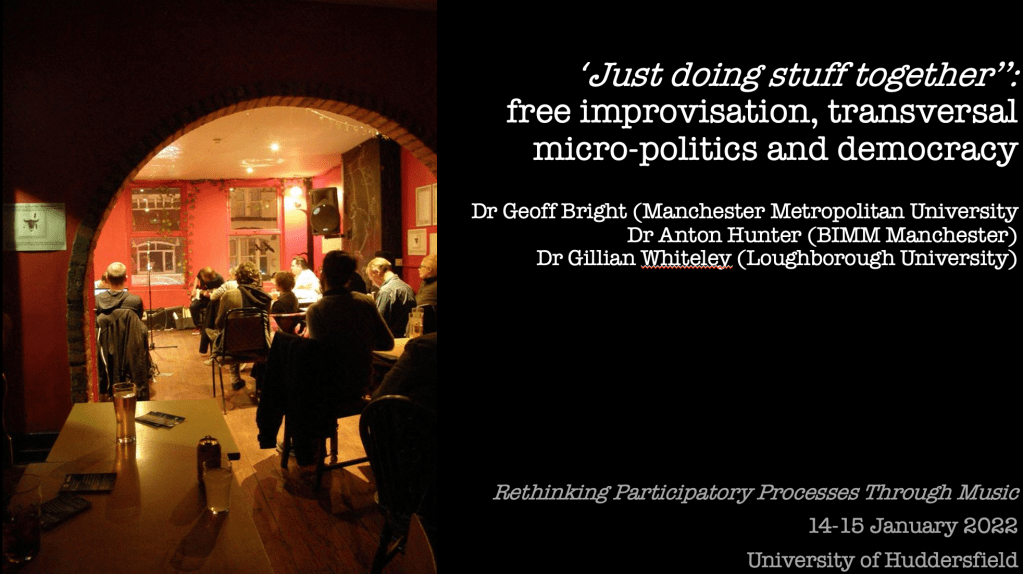
Geoff, Gill, and Manchester-based musician Anton Hunter, presented this paper at a conference in Huddersfield. It was related to an EU funded research project at Manchester Metropolitan University called ‘Partispace’ that looked at forms of participation and their relation to ‘democracy’ across eight European cities. Geoff’s work for the project, supported by Anton, was an ethnographic study of an improvised music scene in Manchester called ‘The Noise Upstairs’. Geoff’s essay, (see the open access version reprinted below) was published in 2022 as a chapter in the main publication for the project.
(Author information: Dr Geoff Bright, Visiting Scholar at the Education and Social Research Institute, Manchester Metropolitan University; Dr Anton Hunter, professional musician and senior lecturer at BIMM Manchester.)
Pulling a Politics out of the Hat at “The Noise Upstairs”
Experimental music, it just kind of opens up many more questions and there’s not really any need to crystallise anything into like a perfect form or idea. You can just make things and they exist (…) It doesn’t necessarily matter [if] it’s a load of shite, it’s just gone and you can have another go, you’ve experienced trying to make something with someone else, a dialogue with someone. There’s just, like, endless potential (…) If anything, it’s a stance against society making us homogenous (‘Owen’, professional musician and Noise Upstairs participant.)
Introduction
The Noise Upstairs (NU) is a monthly ‘free improv’ music night with a home above ‘F Café’, a café bar in a mixed/student suburb of Manchester. This chapter reflects on aspects of the 2016-17 Partispace ethnographic case study carried out there by the authors, both of whom are performer/academics and one of whom (Hunter) organises and compères the monthly NU sessions. What is free improv? A recent trip to a gig would suggest that the following are familiar characteristics. Freely improvised music is created in the moment without any preparation or rehearsal (though we are already begging a host of questions about basic structures and compositional devices, which can sometimes play a part) and is ‘free’ in the sense that constraints imposed by conventions of pitch, harmony, metre, melodic development and generic style are commonly dispensed with or at least experimentally deconstructed. Ensemble performances, most often in small venues like F Café, involve ‘found’, or ‘prepared’ instruments/sound sources as well as conventional instruments and the latter, when played, are frequently played in non-conventional ways using ‘extended techniques’, accidental sounds and extremes of range to produce an idiosyncratic soundscape. Typically, interactive concentration levels are noticeably intense.
In more formal terms, free improv is a post-1960s set of meta-musical practices related to other improvising musics in conceptually complicated historical, musicological, sociological and aesthetic ways, with slippage in descriptive usage between closely related but distinct categories – ‘free improv’, ‘free jazz’ and ‘experimental music’, in particular – that are common among players and enthusiasts. To complicate matters further, European improv and, within it, British improv, have distinctive histories and sonic characteristics (see Bailey, 1992; Heffley, 2005; Hegarty, 2009; McKay, 2005; and Piekut, 2014, for key distinctions, and Barre, 2014; Corbett, 2016; Prévost, 2020, and Toop, 2016, for the performance and listening experience).
As troublesome as definitional niceties are, improvised music is a field where formal academic reflection is becoming more frequent and, even though practitioners often vigorously eschew ‘talking about’ what they do, an international scholar/practitioner-led literature in critical improvisation studies is now relatively well established. Our focus here emerges from reflecting on a now near-foundational view in that literature, namely, that improvisation is an inherently politicised practice, even “a force for political change” (Caines and Heble, 2015, p. 3) as adumbrated in this extract from Fischlin and Heble’s early, 2004, collection.
…there is something singular about improvisation in that improvised performances are marked by degrees of openness, mutuality and collaboration that are heightened and intensified when compared with the interpretation of scored works, and that necessitate participants’ realtime co-creation and negotiation of social-and-musical relationships. From one perspective, then, such performances may become sites for empractising ways of ‘being differently in the world’ based on a ‘recognition that alternatives to orthodox practices are available’ (Fischlin and Heble, 2004, p. 11)
Using Georgina Born’s distinctive work on social aesthetics and improvised music as a springboard (see Born, 2107), we have begun to work with the idea that free improvisation – as a process that performs, par excellence, the “real-time creative decision making, risk-taking, trust, surprise, and collaboration” (Caines and Heble, 2015, p.2) claimed for improvised music generally – is, in fact, a paradigm site of improvisation’s political capacity (see Bright and Hunter, 2018). Here, we extend that account by deploying some concepts from the ‘affective turn’ (Clough, 2007) in social theory to review how the general milieu and out-of-the-hat ensemble-formation approach adopted at NU in fact enables a ‘minor’ micro-political practice of participating differentlyto be enacted there. Arising from that discussion, and in line with a key theme of the wider Partispace study, we then discuss whether that practice might meaningfully (and usefully) be articulated in terms of ‘democracy’. Before commencing in earnest, however, we need to mention some idiosyncratic features of the NU study.
An outlier case-study
In our experience, the NU study has remained something of an outlier both among the Manchester-based studies and among the wider transnational Partispace project as a whole. Initially, some unavoidable institutional organisational factors meant that the study was not established until the autumn of 2016, rather later than the other Manchester studies – a factor that left us feeling at a slight distance from an already active and strongly bonded research project. We were also hesitant about proceeding as NU participants were generally at least at the very upper end of, or slightly over, the Partispace participant age limit of 30 years old – a problematic cut-off in a setting where participants also viewed the presence of much older co- players in an indispensably positive way (as ‘elders’, almost). As a result, we decided to commence the study only when we eventually became convinced that the very definitely intergenerational arts community of NU offered an opportunity to complete a study based in a distinctive cultural setting that was neither conventionally youth-focussed nor conventionally political. As such, it would hopefully help to reflexively problematise the themes of the study as a whole, a laudable research aspiration in its own right.
Further, our methodology was somewhat at odds with the sociologically oriented ethnographic approaches of most otherPartispace studies, being the only one conceived as a “performance ethnography” (Denzin, 2003) with an affinity to the awry, complexifying capacity of post-structural ethnography to “work the ruins of…regimes of truth that have failed us” (St. Pierre and Pillow, 2000, p1), not least ‘democracy’. Involved as performers in all the significant performance elements of our study[1], we modelled our research relationship provocatively on an improvising ‘duo’. Hunter took a participant observer role as NU co-curator and performing musician, while Bright occupied a performance ethnography role as ethnographer and performing musician. Emphasising performance protocols (Soules, 2004) whereby a bi-directional flow of connectivity might be established between our performance selves and our role as ethnographers as conventionally conceived, we improvised our way towards a hybrid research model that might, for want of a more elegant phrase, be best described as a kind of auto-ethnography of transversal performance relations, in which we were actively co-producing the very practices we were observing. This approach inevitably foregrounded ‘affective process’ as a central dimension of performance/creativity, alerting us early on to the possibility of a “politics of affect” (Massumi, 2005) that is imminently and directly social rather than, as is the case with the ‘democratic’ elements of liberal democracy, representationally signified. In short, from the outset our approach amplified our attention to the possibility of democratic potentialities being generated completely beyond the formal framework of political practice in a West European capitalist democracy. Suffice it to say that the outlier character of our study has helped shape this study’s distinctive perspective and our views as they’ve emerged.
The milieu: “affirmation” in “a loose network harking back to the loft movement”
I arrive a bit early in W (Manchester) and have a walk around before meeting Anton. I immediately notice ‘Boho Utopia’ on the corner. Bikes, café culture generally. All a bit East London (…) Around the corner from W Road, where I park the car, it feels suddenly a tougher, ethnically mixed, northern working-class locale. Back on the post rush hour main drag, I hang around outside F-Café, nip in, then hang around outside again, waiting for Anton. When he arrives, we have a useful discussion about how the project might unfold. Upstairs (and they are steep!) instrument cases are strewn by the back wall. A ramshackle but serious DIY atmosphere with a subtly positive, anticipatory buzz. Drum kit and amps are already set up. A young woman is warming up, running scales on soprano sax. An older woman and a guy – her on a tiny electronics set-up, him un-casing an alto sax (…) A woman quietly making a film. (Bright, field notes, winter 2016-17)
Growing out of a perceived need among a small group of musicians around Hunter, NU has been firmly established above F Café,for more than thirteen years now.
There definitely wasn’t anywhere I personally was getting the opportunity to improvise with new people until NU started (…) I’d been playing some improvised small group things with a few different people, and I suggested that we could have our own free-improv jam night in Manchester. ‘K’ approached F Café. ‘T’ came up with the name, and The Noise Upstairs started on July 12, 2007. (Hunter, field notes)
F Café is a busy vegetarian café with a strong community/local character situated a bus/cycle ride away from more commercialised and mainstream music venues in the city centre. It has the DIY feel of the kind of places that thrived until recently in the ‘Northern Quarter’ of Manchester but is also far enough from the study centres of the universities and the Royal Northern College of Music to feel like a ‘home’ or ‘living space’ in which to relax and socialise.
Hunter now views this particular spatial configuration of NU at F Café as a “happy half-accident” (Hunter, interview with GB) that conjures the celebrated 1970s New York ‘loft’ scene (see Heller, 2017) in a number of ways. The performance room is, literally, upstairs – which both isolates ‘the noise’ and demarcates an ‘alternative’ loft-like space. Also, F Café doesn’t have a bar upstairs so the monthly NU session is not a conventional pub night in any usual sense and the ambience is friendly, informal and participatory, but purposeful: “Everyone there, by and large, seems committed to the process”. (‘Gerry’, amateur musician). Also, like the loft movement, which took advantage of cheap rents in ‘undesirable’ areas (Heller, 2017, pp. 26-30) to promote improvised music and a variety of other non-mainstream activities, F Café will not allow an entrance charge to be made. Again, this serves to position the monthly sessions as collaborative and anti-commercial.
The performance space is small and quickly feels full if more than fifteen or so people are present. Just a small gathering feels very concentrated and lively and, with any ensemble larger than a quartet, the playing space is limited.
I attend whenever I can. I look forward to it so much. I like the venue. It has an ambiance that fits the musical style. It can feel a little cramped when there are a lot of attendees, there again you get to speak to lots of people. (‘Val’, amateur musician participant).
As well as the monthly sessions, there is a wider NU network in which some key figures are consistently significant, while others come and go. This network has links to other improv venues across the North West of England and a sister ‘Noise Upstairs’ night has recently been established in Todmorden, in West Yorkshire. Notably, the project defines itself as a ‘collective’ in its webpage mission statement, signalling the broad egalitarianism of NU’s approach to promotion, performance and audience values. In our observation, and congruent with that, there is a genuinely benevolent, affirmative inclusiveness around NU whereby everyone is accepted as participating on their own terms and new participants are welcomed enthusiastically.
Affirmation. I never feel out of my depth and feel appreciated for my efforts (‘Val’)
One thing that’s struck me about NU is that it seems to be a very hospitable scene (…) The genuine acceptance of whatever technical level that people are playing at. Other scenes I’ve known over the years are clique-y. (‘Rick’, professional musician participant)
NU participants have found their way to free improv, and thus to NU, by various routes that in most cases have involved a growing personal distaste for the aesthetics of mainstream musics or an explicit rejection based on politicisation.
Yes, I did music at Uni and I got very discouraged about becoming a musician. I went to [a distinguished conservatoire] and I think when I first went there it was: Oh, I’m going to be an orchestral musician (…) I’m not exactly sure what made that unravel. I think I started to meet other people in Manchester who were involved in more political things. (‘Owen’).
I just wasn’t interested, I didn’t know what music was for. You just sat there and everyone was in lines and you had to get your fingers in the right order to play these letters and you ended up with something vaguely like a tune (…) I didn’t connect with it. I didn’t stay with it for very long. (‘Rick’)
While there is a strong sense of the NU sessions being a part of a small but established improvising world that reaches back to the 1960s, NU player biographies overlap with other Manchester/NW jazz improv venues, the conservatoire, and higher education music departments and a ‘loose but benign collaborative network’ seems an accurate way of describing the relationship pattern of the group of players who congregate at NU.
As soon as you look at it as where relationships come from it makes sense, because we’re involved in doing stuff together and that has no relation to how old we are. We’re interested in doing things together and for similar reasons. (‘Owen’)
Before we move on to consider the randomised formation of ensembles at NU, one cautionary caveat should be mentioned in relation to the milieu. While the egalitarianism of NU is widely felt – the welcoming informality of the atmosphere is a constant in our data – performer patterns (and, remember, performers are also the main audience members at improv gigs) tend to be somewhat stereotypically profiled. During our project, NU participants were predominantly male, with only perhaps 20% of ad-hoc performers being women with the number rising to around 40% of ‘featured artists’ – a lack of gender equity, still notorious in the related domain of jazz (see Whyton and Bruckner-Haring, 2013). What is more, and not unlike classical music or jazz outside metropolitan settings, ethnicity of performers was almost exclusively white. Age profiles were interesting as well. During the case study, the group of participants was made up of predominantly two age groupings: those around thirty years of age and those in their fifties and sixties – a distribution that speaks to two particularly active moments within the music: the period late-1960s to early-1970s, and the last ten years or so (see Toop, 2016; Prévost, 2020).
As a collective, NU is highly aware of, and currently working on, these structural features. Its declared objective is to support improvised music as a collaborative good:
We aim to make [NU] a staple in the improvisation scene by continuing to re-imagine what it can be, and how it can best serve musicians and artists both locally, and abroad. (NU webpage)
To that end, NU also organises musician workshops on a reasonably frequent basis and has in the past released albums on its anti-commercial artist-centric record label, taking artists’ concepts “from idea to physical release in their hand, all for free” – all of which speaks to the generally enabling quality of the milieu at NU. For participants, however, the simple device of allocating ensembles ‘out of the hat’ appears to be key in generating any sense of them ‘being differently in the world’ in which they operate as musicians.
The practice: random ‘conversations’ pulled ‘out of the hat’
[A friend] told me about a night [in Brighton] that a friend of his had been to, called ‘The Safehouse’. Anyone who wanted to join in put their name in a hat and small improvising groups were formed (…) I thought this was a great idea and stole it. (Hunter, research notes)
The format of an NU night is central to how participants are involved. Routinely, sessions involve a mix of trio performances and a ‘guest’ performance. Each trio is made up of randomly selected participants. Basically, anyone who happens to be in attendance can self-nominate and names are literally pulled out of compere Anton Hunter’s hat. The guest set, which will have been promoted via the NU website, is usually sandwiched between first and final ‘sets’ made up of random trios and generally involves a small ensemble with a regional, national or international reputation. In most final sets of the night the guest artists, themselves then randomly selected, join the other participants for trio performances.
According to our observations and the testimony of participants, this format offers a singularly inclusive participatory performance experience that is viewed as valuable to the mix of participants involved. The relatively inexperienced newcomers can have a go in a safe setting; experienced and competent improvisers get to play in ever renewing ensemble arrangements; professionals specialising in improvised and/or other music forms can network among themselves; guest artists can interact laterally with their audience without the barrier of status and everyone gets to experience improvisation in its purest form
The format, which is a very pure form of improvisation (…) seems to me to largely avoid some issues I have with some of the other forms around (…) When you go to NU you genuinely don’t know what you’re going to be doing because that depends on who you get thrown together with, which in turn depends on chance and not someone’s ideas or the outcome of a formula. (‘Gerry’, amateur musician)
The break before the guest act performs provides a great opportunity for interacting with others. (‘Val’)
It was great to able to be able to just have a blow after the concentration of our set (‘Liz’, London-based professional musician and guest artist)
It’s about being in conversation with other people (‘Rick’)
That’s how I got into doing stuff here, by meeting people so I could do things with people and that’s the essential part of it for me – you can’t do it without having a relationship with someone (‘Owen’)
From a personal/social point of view, then, participants primarily gather at NU to hear who’s doing what and where, check out new players, scope out potential collaborations and co-create. The random group setting is generally regarded as a very low pressure, informal one where the social dimension is clearly strong. None of this militates against the value of the aesthetic experience, however. In musical terms, participants obviously bring different levels of practical competence, knowledge and training to their involvement with NU and enter and settle within the community in different ways. As often self-taught as trained, as often relatively inexperienced as experienced, they use the sessions to develop their improvisation and listening skills in playing with differently experienced players in situations that are wholly improvised and where instrumentation is often unusually clustered in unpredictable and unfamiliar ensembles. One professional, who is also a teacher in a university music department, sees NU sessions as directly informing his teaching.
I went back to the students and told them at that time: You ALL need to go to this event because we’re all…everyone is less good with their ears than they can be (…) And so I was like a regular from then on really. (‘Rick’)
In the trio sessions in which we participated and observed, energy was invariably high with satisfaction in the aesthetic quality of performances frequently being emphatically registered. Participants were often also visibly excited after a trio and a collective sense of well-being was palpable when musical interaction was significant and meaningful. Contributions by all participants were warmly received by the audience (largely the players who were not playing) and the more aesthetically developed ones were vigorously applauded.
Picking players out-of-the-hat – all done with due mock theatricality – is a great idea. A bit of fun for sure, but the shape of the random ensembles is a constant surprise and the unexpected sonic combinations are generally really refreshing to the ear. There might be three guitars (or saxes, or electronic set-ups) or none, in any trio. I also like the way the guest artists also participate in the out-of-the-hat session with everyone else. That really challenges the usual hierarchy. (Bright, field notes)
There’s no safety, no hand holding, no form, no harmony. All you can do is listen. So, yeah, I’m increasingly fascinated with free improvised music. It’s just the purity of it. (…) the pleasure in trying to understand it benefits every other component of what you do as a musician. (‘Rick’)
As one would expect, different groupings were differently productive in aesthetic terms but the performers seemed not to be exercised by this, moving happily back into the social field of networking as soon as they put their instruments down.
An ‘alter-accomplishment’: Social aesthetics, affective intensities and event-care
What is happening here? Certainly, the materials we’ve assembled register the presence – and co-constitutive nature – of both social and aesthetic elements in the milieu and the practice regime at NU and that looks very similar to what Georgina Born has described as the ‘empractice’ of social aesthetics. Born, herself a researcher/improviser (and founding member in 1977 of FIG, the Feminist Improvising Group) has indicated four key ways in which the political character of improvised music is evident in how the musicians operate.
[They have] shown interest in the aesthetic potential and/or effects of the socialities of performance …[they] have shown a concern with how wider, enduring social relations of difference – of race, class and/or gender, for example – enter into and may be reproduced, entrenched, refracted or re-imagined in the socialities of musical performance…[they] have seen an active engagement with institutional forms, primarily those through which their music is produced and distributed, as a necessary or even unavoidable extension of their creative practice. [And]… like socially-engaged art, improvised music has in some of its manifestations been engaged in catalysing wider political struggles for social justice and social equality (Born, 2017, p. 50)
The first three of these domains of interest – emphasising socialities of performance, challenging the reproduction of social relations of difference, and critically engaging with institutional forms – are all clearly evident at NU though the fourth, engagement with “wider political struggles” is not and Hunter has made the point that “we don’t position ourselves [at NU] explicitly as trying to mount any kind of social critique” (interview with Bright, January 2017).
The core of social aesthetics is a “rejection of the claim…that one can or should disentangle the social, in all its varied modalities, from experiences and conceptions of the aesthetic” (Born, Lewis and Straw, 2017: 2). Indeed, the argument is that the aesthetic and the social are not only contingently co-productive but are, in fact, inherently related. Art, music and performance practices are “immanently social” and can, in improvised performance, actually establish “novel realms of social experience, new modes of sociality” (op cit. 2017, p. 9 our emphasis) through a hybrid process the authors designate as ‘empractice’. What is more, improvisation “cannot but empractice or manifest a social aesthetics” (p.9. Original emphasis). Essentially, then, SA accentuates the capacity of art and music “to both influence social processes and to put into practice, model, enact, and experiment with novel socialities and social relations of diverse kinds” (op. cit. 2017, p.6. Our emphasis). On this account improv is, quite literally, a world-changing practice.
Eddie Prévost, another UK practitioner/commentator (and founding member of the free improvising group, AMM, in 1965) has also produced a body of work emphasising the collective interactivity of “meta-music” and has identified “two analytical propositions” as characteristic of free improvisation: the “problem solving” techniques within performance and the “dialogic interrelations between musicians” (Prévost, 1995, p. 172). In an early article, the title of which – ‘Meta-music and the mutating monster of possessive individualism – an epic struggle’ – is unambiguous about its politics, Prévost described a very similar social dimension to that recognised by Born.
Every time we listen we have the possibility of making a new world… We test our responses against experiences – depth-sounding for life. And within collective responses, sounds and their attached meanings, become sounding boards of social existence. (Prévost, 1995, p. 180)
Again, we recognise this description. Both Born and Prévost focus squarely on the relational qualities of social interaction and how they prefigure a different sociality. Neither, however, respond to the intensive flows that, in our experience, are integral to free improvisation. Consequently, and before settling on a description of just what kind of a politics is being pulled out of the hat at NU, we suggest building on their work by introducing some literature from the ‘affective turn’ in social theory (Clough 2007) and deploying some of the concepts found there. Deriving ultimately from Spinozan ideas of ‘affect’ as naming the distinctive power of bodies to form new and empowering encounters, affect theory has been summarised as drawing the following broad conclusion:
Affect is an impingement or extrusion of a momentary or sometimes more sustained state of relation as well as the passage (and the duration of passage) of forces or intensities. That is, affect is found in those intensities that pass body to body (human, non-human, part-body, and otherwise), in those resonances that circulate about, between, and sometimes stick to bodies and worlds, and in the very passages or variations between these intensities and resonances themselves. (Seigworth and Gregg, 2010, p1. Original emphasis)
The salient points for us here are, first, the articulation established between mobile states of relation and flows of intensity as processual, as a ‘becoming’. Second, the more-than-human notion of ‘bodies’ that is employed and, thirdly, the idea of ‘resonances’ that ‘stick’ in assemblages of bodies and worlds. This is where, we suggest, improvisation’s distinctive politics is generated. The novel notions we wish to borrow from this terrain are twofold: that of a distinction between ‘minor’ (or ‘molecular’) and ‘major’ (or ‘molar’) politics (familiar to Born, if not Prévost), and the idea of ‘transversal micro-politics’[2]. The minor/major distinction is developed across that (joint) work of Gilles Deleuze and Félix Guattari that problematizes the relationship of ‘capitalism and schizophrenia’ (see Deleuze and Guattari, 2004a and 2004b). [T]ransversal micro-politics, on the other hand, is most emphatically presented in the solo writing Guattari produced on transversal group relations in institutional and political group settings (see, for example, Guattari, 2000 and 2015).
According to Thoburn (2003), in broad terms ‘minor and major’ are expressions
…that characterize not entities, but processes and treatments of life. Essentially, molar [or major] processes are premised on the formation and defence of a constant or a standard that acts as a norm and a basis of judgement. As such, major relations are relations that are fixed and denumerable. (Thoburn, 2003, p7. Original emphasis)
Minor relations, in contrast, are “found in concrete moments of deviation from the dominant, model” (p.7). As an example of a limiting major (molar) politics, Parliamentary democracy (with its fixed representational structures) might well be a likely candidate. A minor (or molecular) politics, in contrast, is fundamentally processual, being “an affirmation of new senses, new lives, or new possibilities… a politics of invention’ (p.6) that urges flight from the logics of capitalism. ‘Transversality’, Guattari’s neologism, similarly expresses an explicitly liberationary dimension, this time of group relations
[ Transversality] tries to overcome both the impasse of pure verticality [hierarchy] and that of mere horizontality: it tends to be achieved when there is maximum communication among different levels [of a group] and, above all, in different meanings. (Guattari, 2015; 113)
Both of these notions are foundational to the broader account of the ‘politics of affect’ – really, in this vocabulary, a minor politics of transversal, micro-politically productive, relations – proffered, largely as a development out of Guattari’s work, by Massumi (2015).
By the end of the nineteen eighties, Guattari (2000) had proposed a ‘mental ecology’ (alongside an ‘economic’ and an ‘environmental’ ecology) as a third key dimension of our necessary escape from what he called Integrated World Capitalism. Key to that mental ecology would be a ‘re-singularisation’ of subjectivity. In Guattarian group-work practice, re-singularisation is the micro-political dimension of transversal relationality whereby a group moves from the paralysis of the ‘subjected’ or ‘dependent’ human group to the autonomy of the ‘subject’ group. Micro-politics is thus an aesthetic-existential-affective process that is inherently anti-individualistic and which, importantly for our purpose here, pushes resolutely beyond any model of politics framed within the representational arrangements of liberal democracy – aiming, instead, towards “a being-for, to a collective intentionality, turned toward doing…” (Guattari and Negri, 2010, p. 92).
Massumi draws explicitly on this material to describe the ‘micro-political’ domain in detail. Micro-politics, he argues, occurs when relational affective/aesthetic processes return us to the “generative moment of experience at the dawning of an event” (Massumi, 2015, p.79). Each such moment, experienced ‘micro-perceptually’, opens the possibility of “reconnecting processually with what is germinal in… living” and raises the prospect of “living more intensely, more fully, with augmented powers of existence” (p.79). According to Massumi, affective politics initiated at a micro-political level “seeks the degrees of openness of any situation, in hopes of priming an alter-accomplishment” (p.52. Our emphasis).
Two further, and related, concepts from Massumi’s Politics of Affect are also valuable to us. These are ‘event-design’ and ‘event-care’. Massumi describes event-design as a shifting of the stakes of events away from issues or definable outcomes to “what can be done to open up new ground for exploration and invention that re-energises people and makes their lives …more liveable and intense” (Massumi, 2015, p.73). Event-care is, in the words of Massumi’s collaborator, Erin Manning, an experiment in
[R]econnecting to the collective in a different way, getting away from thinking about ‘being active’ in the sense of ‘doing something’ and focusing instead on ‘something doing’. This brings us back to the earlier question of affect: what does it mean to co-compose? … one of the ways we move towards this question of collective value is through the concept of event-based care… a kind of collective tending… (Erin Manning, in Massumi, 2015. pp.164-165. Our emphasis)
‘Finding democracy in music’?
Why is this theoretical excursion necessary? For two reasons. First, because it speaks so very accurately and directly to the spaces and styles – mobile; intense; in shifting assemblages of players/audience/instruments; multiply embodied; attentively listening, while at the same time spontaneous – of what it is to improvise. It is also completely congruent with our half-deliberate/half-happenstance outlier improvisatory methodological outlook. The concepts and terminology deployed – the orientation to ‘something doing’, to the ‘joyous’ power of affect (Gilbert, 2014, chapter 6, para.7), to transversal rather than hierarchical relationships, to what is tantamount to the collective tending of ‘event-care’, and to the potential of a micro-political, minor politics of “being differently in the world” – glow luminously throughout both our data and our own ‘duo’ research relationship.
We need this theoretical orientation, secondly, because the thorough-going anti-essentialist de-centering of the human subjectimplied by affect theory (as, broadly, a species of post-structuralism) thoroughly problematises the ‘unified identity’ inherent to liberal democracy and, thus, impinges on the question of whether we might reasonably describe the performance mode and milieu of NU as ‘democratic’. It has to be said, ‘democracy’ was a term that was never uttered once during our study, and any politics discernible there was enthusiastically lived rather than talked about. More often than not, our young(ish) participants presented themselves as well aware of the difference between what they do as free improvisers and any conventional politics. ‘Owen’, our most explicit commentator on the political nature of free improvisation as a process of relational becoming, was well aware of the tension between the two domains, pursuing the infinite reach of the one while withdrawing, exhausted, from the other.
[In improv] you realise you have something in common in how you approach things or understand things… just the act of doing. Yeah. I’d like to feel you could push that just to infinity… I just don’t have a lot of truck with certain kinds of activist attitudes or the idea of being part of a group ‘cos when I went to climate camps and stuff like that and the fracking thing, I went to that one, I’ve always felt side-lined on those kinds of things (‘Owen’)
Can we commit, then, to situating NU as a site of ‘democratic’ practice? This question remains a tricky one. We are certainly comfortable enough to say that a minor-politics is being generated at NU. The notion of ‘minor’ as discussed above seems ideally suited to the form of participation that occurs at NU and in much free improv more generally. As for ‘democracy’, we remain more circumspect. It depends, of course on what the term might mean. It is clearly the case that key dimensions of ‘democracy’ as highlighted by the larger Partispace project in which this study sits – ‘recognition and belonging’, ‘finding voice’; ‘transition’; ‘biographical pathways in participation’; ‘participatory strategies and tactics’, ‘diversity of styles’, and ‘improvisation and creation of democratic life’ – are visible in the ethnographic materials we’ve considered. They are visible, however, not becausethey are analytically separable within an established academic literature of democratic youth participation, but in spite of that: as inseparable, affective efflorescences of a living, unfixable, irreducibly social process.
We acknowledge that the last ten years or so has seen a steadily growing interest in clarifying the relationship between democracy and music, and accounts are variously theorised. Prévost, for example, has recently reiterated how aspects of the explicitly politicised[3], Maoist-influenced, practice that he helped initiate in AMM during in the 1960s might still shape a vision of a democratic music.
(K)ratia: the freedom of the individual to make musical choices unimpeded by the imperatives arising from prescription, be they ruled by tradition or market forces.
(D)emos: a sympathetic and creative sense of association in which individuals and humanity can flourish: taking and giving inspiration through dialogue and enjoying the company of others. (Prévost, 2020, p. 222)
Other work, influenced by post-structuralist sensibilities, has taken other directions. For example, US-based improviser/researcher Tracy McMullen has deployed an interesting hybrid perspective rooted in an integration of Derrida’s (1996) notion of an always already present ‘democracy to come’ and some Buddhist notions of direct experience, to describe a present/possible democracy in improvisation that certainly resonates with the “endless potential” and “push…to infinity” identified above by our participant ‘Owen’.
This could be the practice of democracy: this vulnerable opening to the new that carries with it a ‘sense’ of responsibility, a feeling of responsibility, not an idea or decision of what is responsible but a responsiveness, a willingness, an ability to respond to the singular moment in a courageous, open-ended, continuous, indeed infinite (never-ceasing) manner (McMullen, 2013, p. 274).
Most recently, in a co-edited collection called Finding Democracy in Music Robert Adlington, while emphasising that a relationship between ‘democracy’ (or, at least, a liberal democratic imaginary) and music has been asserted for over a century, warns that democracy remains a “heterogeneous concept, comprising intrinsically contested territory” (Adlington and Buch, 2021, p. 3). Pursuing the matter nonetheless, Adlington has employed deliberative theories of democracy to consider claims that rationally choiceful, egalitarian relationships are frequently established in small musical ensembles (see, Adlington 2020). Reviewing the case of classical string quartet and small group jazz performance where such claims are frequently made, Adlungton finds them to be more aspirational than actual. Turning more hopefully to group-based free improvisation he is disappointed there as well, offering a strong counsel of caution at democratic legitimacy seemingly always “requiring exclusion” and the consequent implication that any egalitarian practice is thus “always situated between exclusion and incommensurability” (Adlington, 2020, slide entitled: ‘The prospects for an inclusive musical practice’).
Our sense is that only a radical democracy reaching beyond the limited scope of the liberal individual can navigate this apparent impasse and accommodate the micro-level “brewing, the world stirring”, in Massumi’s powerful phrase, (2015, p.52) that resounds upstairs at F Café every second Thursday of the month. Furthermore, it would have to be a radical democracy that sees democracy as experimentally emergent within a living affective/aesthetic process. Space effectively necessitates our not getting involved in any discussion of the contested varieties of radical democracy and we are happy enough to let Jeremy Gilbert (one of the shrewdest contemporary commentators on both democracy and improvisation) speak for us on that (see Gilbert, 2008, and 2014). What we have found, though, is that our use of performance ethnography refracted through affect theory has very quickly alerted us to what Gilbert, coming from a very similar theoretical perspective to us, has called the “rhizomatic moment of improvisation” – a moment that is certainly a recognisable commonplace at NU:
The sociality of improvising musicians is always constituted of transversal relations which cannot be understood in terms of a logic of signification…no element of music makes more vivid this dimension than the irreducibly social moment of improvisation…In the impure spontaneity of real-time composition/performance there is necessarily a moment of becoming-music at which the boundaries between performer and performed, between audience and compositions, between musician and instrument, between musicians and each other are all blurred: this is the moment of the opening onto ‘the Cosmic’ which is also an experience of sociality as such. (Gilbert, 2004, p 125 original emphasis)
Furthermore – and leaving aside the matter of the ‘cosmic’, for now – for Gilbert, this just is democracy
[W]hat democracy means, in its fullest sense, is just the expression of that complex creative potential which inheres in every group or collectivity. (Gilbert, 2014. Preface, para.10. Our emphasis).
So, in so far as we are happy enough to be persuaded by Gilbert’s position, we remain fairly relaxed about Noise Upstairs’rambunctious, out-of-the-hat and emphatically minor politics therefore being counted as one of the ‘democratic experiments’ that Partispace has successfully reported on and catalogued. We remain, though, well aware that any approach such as ours bumps up very quickly against the stubbornly insistent question of how micro-political beginnings might be scaled-up and completed in the macro-political spaces where democracy most commonly stakes its claims: a thorny discussion, for sure, that can only really be adequately developed as the findings of the whole Europe-wide Partispace project are disseminated.
References
Adlington, R. & Buch, E. (2021). ‘Introduction: looking for democracy in music and elsewhere’. In Robert Adlington & Esteban Buch (eds) (2021) Finding democracy in music, London and New York: Routledge. n.p. Kindle version.
Adlington, R. (2020). ‘Practising egalitarianism: small ensembles, free improvisation and democracy’. Royal Northern College of Music Research Forum Zoom Seminar, 7 October 2020. Accessible at https://www.youtube.com/watch?v=7oF4TN7ce5U
Bailey, D. (1992). Improvisation: Its nature and practice in music, London: The British Library.
Barre, T. (2014). Beyond jazz: plink, plonk and scratch. The golden age of free music in London 1966-72, Brentford: Compass Press.
Born, G. (2017). ‘After relational aesthetics: Improvised music, the social, and (re)theorizing the aesthetic’. In Born, G., Lewis, E. & Straw, W. (eds.) Improvisation and social aesthetics, Durham, North Carolina: Duke University Press.
Born, G., Lewis, E. & Straw, W. (eds.) (2017) ‘Introduction’. In Improvisation and social aesthetics, Durham, North Carolina: Duke University Press, pp. 1–30.
Clough, P.T. (2007). The affective turn: Theorising the social, Durham and London: Duke University Press.
Corbett, J. (2016). A listeners’ guide to free improvisation, Chicago: University of Chicago Press.
Denzin, N., (2003). Performance ethnography: Critical pedagogy and the politics of culture, London: Sage.
Derrida, J. (1996) ‘Remarks on deconstruction and pragmatism’. In Chantal Mouffe (ed.) Deconstruction and pragmatism, New York: Routledge, pp. 77–88.
Fischlin, D. & Heble, A. (2004) ‘The other side of nowhere: Jazz, improvisation and communities in dialogue’ In Daniel Fischlin and Ajay Heble, (eds). The other side of nowhere: Jazz, improvisation and communities in dialogue, Middletown CT: Wesleyan University Press, pp. 1–45.
Gilbert, J. (2008) Anticapitalism and Culture: Radical Theory and Popular Politics.Oxford and New York: Berg
Gilbert, J. (2004) “Becoming-music: The rhizomatic moment of improvisation” in Ian Buchanan and Marcel Swiboda (eds.) (2014) Deleuze and music, Edinburgh: Edinburgh University Press.
Gilbert, J. (2014). Common ground: Democracy and collectivity in an age of individualism, London: Pluto Press (Kindle version).
Guattari, F. (2000). The three ecologies, London and Brunswick NJ: Athlone Press.
Guattari, F. (2015) ‘Transversality’ in Guattari, F (2015) Psychoanalysis and transversality: Texts and intervies 1955-1971. Pasadena, CA: Semiotext(e).
Guattari, F. & Negri, A. (2010) New lines of alliance. New spaces of liberty, New York: Autonomedia. Originally published in French in 1985 as Les nouveaux espaces de liberté. First English edition, 1990, published under the title Communists like us.
Heble, A. & Caines, R. (2014) (eds.) The improvisation studies reader: Spontaneous acts, London: Routledge.
Heffley, M. (2005). Northern sun/southern moon. Europe’s reinvention of jazz, Yale University Press: New Haven and London.
Hegarty, P. (2009). Noise/music a history, New York and London: Continuum.
Heller, M. (2017). Loft jazz: Improvising New York in the 1970s, Oakland: University of California Press.
Massumi, B. (2015). The politics of affect, Cambridge: Polity.
McKay. G. (2005). Circular breathing; The cultural politics of jazz in Britain, Durham NC: Duke University Press.
McMullen, T. (2013) ‘People don’t get ready: Improvisation, democracy and hope’. In People get ready. The future of jazz is now’. In Ajay Heble and Rob Wallace, (eds) People get ready. The future of jazz is now, Duke University Press: Durham NC and London, pp. 265–279.
Prévost, E. (1995) No sound is innocent, Harlow: Copula.
Prévost, E. (2020) ‘Democracy and music’. In An uncommon music for the common man. Harlow: Cupola, pp. 219–225.
Piekut, B. (2014) ‘Indeterminacy, free Improvisation, and the mixed avant-garde: Experimental music in London, 1965–1975’. In Journal of the American Musicological Society, 67 (2014), pp. 769–824.
Seigworth, G. J. & Gregg, M. (2010). ‘An Inventory of Shimmers’. In Gregory. J. Seigworth, and Melissa Gregg, (eds). (20100. The Affect Theory Reader, Durham NC and London: Duke University Press. pp 1–25.
Soules, M. (2004). ‘Improvising character: Jazz, the actor, and protocols of improvisation’. In The other side of nowhere: Jazz, improvisation, and communities in dialogue, Daniel Fischlin and Ajay Heble (eds), Middletown CT: Wesleyan University Press, pp. 268–297.
St. Pierre, E. & Pillow, W. (2000) ‘Introduction: Inquiry among the ruins’. In Elizabeth A. St. Pierre and Wanda S. Pillow (eds) (2000) Working the ruins: Feminist post-structural theory and methods in education. New York and London: Routledge. pp. 1–24.
Thoburn, N. (2003) Deleuze, Marx and Politics, London, Routledge.
Toop, D. (2016). Into the maelstrom: Music, improvisation and the dream of freedom before 1970, London: Bloomsbury.
Whyton, T & Bruckner-Haring, C. (eds.) (2013). Statistical overview of five partner countries, Graz: Institute for Jazz Research, University of Music and Performing Arts Graz.
[1] In addition to participating in the monthly NU nights, the study funded a short series of workshops in preparation for a performance of John Zorn’s ‘game’ piece, Cobra; a subsequent performance of Cobra at a small day-long festival called the NUstival and guest performer slots, all of which we were both involved in.
[2] See chapters 1 and 2 of Thoburn’s (2003) discussion of minor and major politics in his, Deleuze, Marx and politics. More broadly, see Gilbert, (2004) for a discussion of improvisation in light of Deleuze and Guattari’s influential legacy and Gilbert (2014, chapter 6) for a general overview of the significance of their work for discussions of democracy.
[3] See ‘AMM and the practice of self-invention’ in Prévost, 1995. pp 9-29
 polimprov